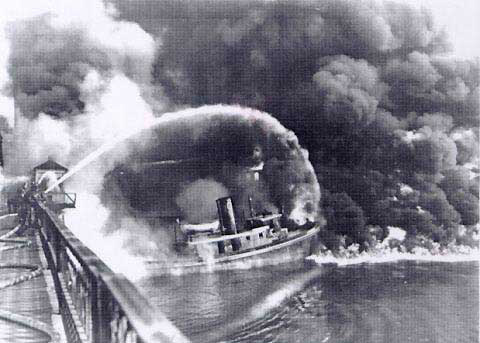
...not once, but 13 times. Cuyahoga river of the USA in Ohio state.
Some other intersting facts about the river:
- The river, whose name means the "crooked" river, is almost 150 kms long. Its called crooked because it flows in NNE to SSW direction for a little over half its distance and then drastically changes course (forming numerous branches and joins and lakes) to flow in SSE to NNW direction. The river flows into the Lake Erie.
- Moses Cleaveland, who was a surveyor formed and establishment along the mouth of the river, the city now known as Cleveland.
- It is said that the river is so slow at its mouth, that Time magazine literally termed it as river "oozing" rather than "flowing" and it was at times so polluted that it was termed as river in which a person does not "drown" but "decays".
- Following extract (about pollution) is from A Kent State University symposium, convened one year before the infamous 1969 fire, described one section of the river:
- "From 1,000 feet below Lower Harvard Bridge to Newburgh and South Shore Railroad Bridge, the channel becomes wider and deeper and the level is controlled by Lake Erie. Downstream of the railroad bridge to the harbor, the depth is held constant by dredging, and the width is maintained by piling along both banks. The surface is covered with the brown oily film observed upstream as far as the Southerly Plant effluent. In addition, large quantities of black heavy oil floating in slicks, sometimes several inches thick, are observed frequently. Debris and trash are commonly caught up in these slicks forming an unsightly floating mess. Anaerobic action is common as the dissolved oxygen is seldom above a fraction of a part per million. The discharge of cooling water increases the temperature by 10 to 15°F. The velocity is negligible, and sludge accumulates on the bottom. Animal life does not exist. Only the algae Oscillatoria grows along the piers above the water line. The color changes from gray-brown to rusty brown as the river proceeds downstream. Transparency is less than 0.5 feet in this reach. This entire reach is grossly polluted"
- First fire occurred in 1868. And there have been nearly a dozen more fires over next hundred years, most of them occurring in last two decades.
- The largest river fire was in 1952 causing damages of over USD 1 million. Many river front buildings were damaged in that fire. One of the subsequent fires (last one occurring in 1969) also featured on Times magazine cover page.
- Following link points to one of the images from original fire. Picture.


No comments:
Post a Comment